

Some of my favorite posts on Mind The Beet are my v2’s - I let a post sit for a while and return to it after having lived more life. In Nov 2025, I wrote a post on leading an existing product through an AI transformation. This was in hindsight an ironic publication date because it was published the month that the Anthropic models first came out that have so upended tech teams’ coding practices. So, it turns out everything I wrote in that post was before the actual tidal wave.
Today, I return to this post - updating it after a crazy year of tech upheaval & production function changes that have required me to continue to rehire myself for the times.
Fire & Rehire: An Andy Grove-ism.
One of my favorite stories in the history of tech is how Andy Grove at Intel responded to a changing business environment. Intel’s original product was memory chips and Japanese memory companies were dumping cheap chips on the US market. It was clear that Intel’s entire business needed to change, which lead them to pivot to making CPUs.
Andy Grove realized it wasn’t just the business that needed to change - how he showed up as a leader and the entire culture of the company needed to shift in order to transform. As this came into focus, he famously fired himself, physically walked out of his office door, and walked back in with intentionally on how he was going to lead through the crucible.
Navigating the Crucible: 10 Behavior Changes
So, what’s my version of walking out and walking back in? I’ve landed on 10 behavior changes that I’m holding myself accountable to.
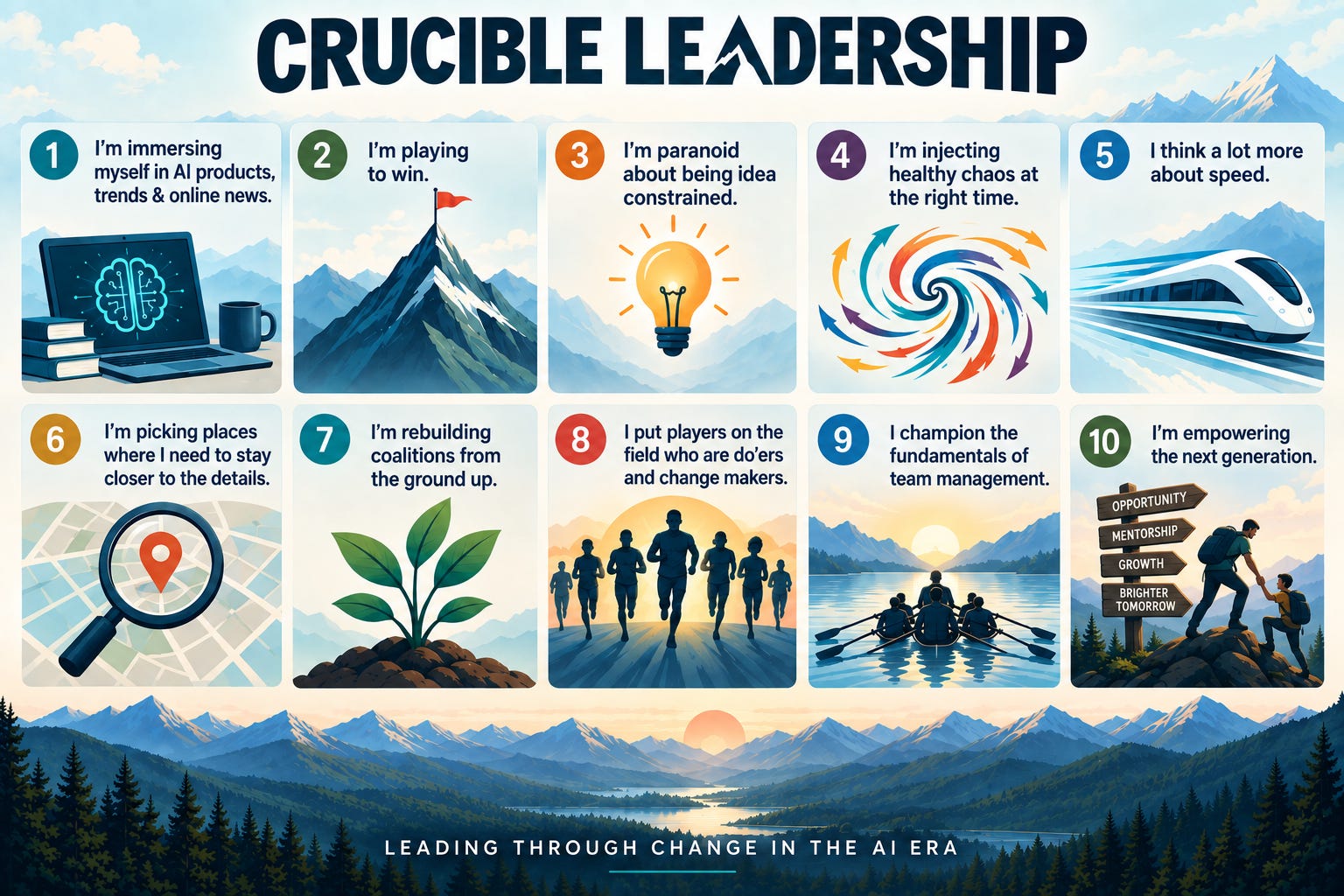
I’m immersing myself in AI products, trends & online news.
Someone on my team said this week “I can tell the difference between someone who uses AI vs. lives AI.” This captures the needed change perfectly - AI dogfooding, AI news reading, AI automations - it’s about stretching beyond the norm to the frontier and having opinions about the trends. If you aren’t living it, you can’t build it.
I’m playing to win.
This “playing to win” is another turn of phrase from a peer of mine. For me, it means prioritizing mission clarity, talking using impact language, and showing up with passion for ever bolder goals. While winning is always important, crucible times often have ambiguity anxiety, which leads people to celebrate progress over results. This counters that incrementalism.
I’m paranoid about being idea constrained.
Agentic coding factories are enabling coding team to get more done, quicker. My historical intuition of the size of the needed product backlog is wrong - we can do more now. Labs, incubations, higher ambition v1’s - I’m creating ways where product and design spend more of their time on idea generation to stay ahead.
I’m injecting healthy chaos at the right time.
I pride myself on providing stability and making people feel seen for achieving the goals they set out to achieve. That’s still a part of my job, but now I’m less afraid to reset goals, raise the bar, and “question the plan” more frequently. I want to create missions that stay just out of reach - so when the tech gets better, we aren’t caught off guard.
I think a lot more about speed.
Moving fast always mattered, but now I think in days and weeks more often. I prioritizing figuring out the “one-way doors” we can’t unwind, letting everything else move quicker. I spend more cycles asking “what’s not working” and take action decisively. I set a culture where leadership intervention isn’t “an escalation” but the norm for this early stage.
I’m picking places where I need to stay closer to the details.
Four years ago, 80% of my job as a portfolio owner was editing the work of others. That’s still a part of my job - but there is no way I’ll have the lived experience I need to lead through change if I’m that far removed. So, I’ve chosen intentional projects to go deep on and co-design with the team.
I’m rebuilding coalitions from the ground up.
There is so much industry churn and company reorganizations that it forces a reset in the cross-team partnerships. I’m leaning in to make this healthy coalition building for a new era - and it’s intentional that this starts top down to reduce churn for the team.
I put players on the field who are do’ers and change makers.
There will be a time for systems builders and process junkies again - but for now I’m prioritizing choosing people who exemplify many of the traits in this post: impact drivers who don’t take no for an answer and suffer no delays.
I champion the fundamentals of team management.
Management is getting a bad rap in 2026 - it’s the cult of “member of technical staff” titles, org flattening, and more reports-per-manager that all signal that management isn’t valued. I’ve chosen to intentionally counter position here - I believe the fundamentals of management stay as relevant as ever: I focus on what each member of my leadership team needs from me, create a culture of excellence, and continue to authentically model/coach/care.
I’m empowering the next generation.
I personally benefited from the last wave of disruption: My leadership bet on me as an emerging leader with new ideas as we built cloud services for the first time. I’ve made it a point to reach out to multiple layers of the organization to solicit ideas, give visibility to cool work, and encourage risk taking.
A New Hope: It’s All A Repeating Cycle
The good news about 2026 - we’ve been here before. The industry is a repeating cycle of technical shock, category recreation, product/market fit, and scale. And while the early stages are more stressful than average for existing products, it’s a well-worn path - even as AI makes change manifest in new ways. And it gives me deep purpose to build resilient software that customers can trust, and an operating environment that adapts so people can do career defining work.
Onwards to the new era!